No products in the cart.


Solar Battery Price in Nigeria (2026) — Complete Buyer’s Guide
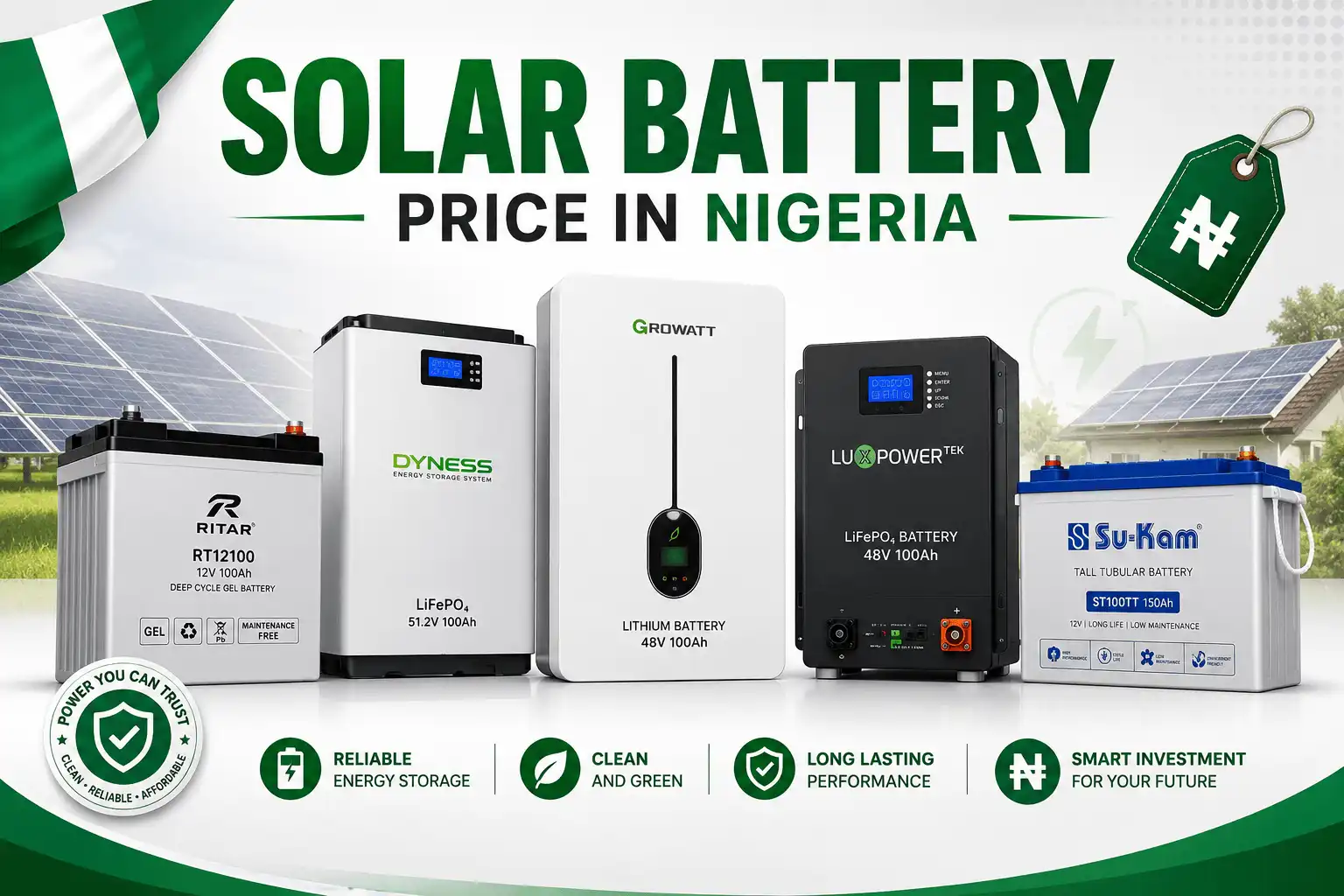
Solar battery price in Nigeria ranges widely from ₦155,000 to over ₦5,500,000, depending primarily on the storage technology, capacity, and brand. Standard 12V 200Ah/220Ah tubular or deep-cycle gel batteries generally cost between ₦160,000 and ₦479,000 per unit. In contrast, longer-lasting Lithium Iron Phosphate (LiFePO4) solar batteries offer premium storage but higher upfront costs: entry-level 2.5kWh lithium units scale from ₦580,000 to ₦695,000, mid-range 5kWh lithium batteries cost between ₦995,000 and ₦2,148,000, while high-capacity 10kWh to 15kWh lithium systems range from ₦1,136,897 to over ₦4,200,000.
Many buyers focus heavily on panels and inverters, then buy the cheapest battery available — only to replace it 12 to 18 months later at full cost again. In 2026, more Nigerians are moving from old-style tubular batteries to LiFePO4 lithium batteries for longer lifespan and better performance.

This guide covers every battery type, every major brand, current prices across all capacities, and how to choose the right battery for your home or business in Nigeria.
Not sure which brand to choose? See our best solar batteries in Nigeria guide.
Solar Battery Prices in Nigeria 2026
| Battery Type | Capacity | Price Range (₦) |
|---|---|---|
| Tubular (Lead-Acid) | 100Ah | ₦130,000 – ₦200,000 |
| Tubular (Lead-Acid) | 200Ah | ₦155,000 – ₦420,000 |
| Gel / AGM | 200Ah | ₦160,000 – ₦350,000 |
| Lithium LiFePO4 | 100Ah (12V) | ₦180,000 – ₦285,000 |
| Lithium LiFePO4 | 200Ah (12V) | ₦315,000 – ₦470,000 |
| Lithium Pack | 2.5kWh | ₦580,000 – ₦695,000 |
| Lithium Pack | 5kWh | ₦995,000 – ₦2,148,000 |
| Lithium Pack | 10kWh | ₦1,136,897 – ₦3,100,000 |
| Lithium Pack | 15kWh | ₦2,300,000 – ₦4,200,000+ |
In-Depth Price and Capacity Comparison Table
This quick-reference index helps balance your specific budget with your power expectations:
| Battery Capacity & Type | Estimated Price Range (₦) | Usable DoD / Lifespan | Best Suited For |
|---|---|---|---|
| 12V 200Ah Tubular | ₦160,000 – ₦310,000 | 50% / 2–4 Years | Low-cost setups, lighting, fans, TVs. |
| 12V 220Ah Premium Tubular | ₦295,000 – ₦479,000 | 50%–60% / 3–5 Years | Standard home backup, medium fridge, laptops. |
| 2.5kWh Lithium (LiFePO4) | ₦580,000 – ₦695,000 | 80%–90% / 10+ Years | Modern apartments, basic work-from-home rigs. |
| 5kWh Lithium (LiFePO4) | ₦995,000 – ₦2,148,000 | 90% / 10+ Years | 3-Bedroom flats, deep freezers, constant pumping. |
| 10kWh Lithium System | ₦1,400,000 – ₦3,100,000 | 90% / 10+ Years | Large duplexes, inverter ACs, small businesses. |
| 15kWh+ Premium Lithium | ₦2,200,000 – ₦5,300,000 | 90% / 12+ Years | Office complexes, estate hubs, mini-grids. |
Data sourced across major equipment hubs like Alaba International Market, Jiji Nigeria, and verified online stores like Konga reflect the following pricing:
- Enviro+ 200Ah / 12V Tubular: ₦160,000 – ₦190,000
- Genus 200Ah / 12V Tubular Wet Cell: ₦170,000 – ₦210,000
- Motex Energy 230Ah / 12V Tubular: ₦285,000 – ₦300,000
- Mercury 220Ah / 12V Tubular: ₦295,000
- Luminous 220Ah Volt Charge Tall Tubular: ₦310,000 – ₦330,000
- Eastman 12V 220Ah Tall Tubular: ₦478,050 – ₦479,000
- Standard Solar Gel Battery (200Ah / 12V): ₦469,000
Total Solar System Bundles (Inverter + Battery + Panels)
Most reputable local installers recommend purchasing balanced, turnkey bundles rather than buying random pieces on your own. This ensures your charge controller can communicate properly with your battery’s internal management system (BMS).
Turnkey operational packages across top retailers mirror these configurations:
- Small Residential System (1.5KVA – 2KVA): Composed of a basic inverter unit, two 220Ah tubular batteries, or a 2.5kWh lithium block alongside 4 monocrystalline solar panels averages ₦1,250,000 to ₦1,600,000.
- Standard Mid-Tier Flat System (3.5KVA to 5KVA): Configured with a 5kWh lithium battery pack and high-efficiency roof solar panels ranges from ₦2,950,000 to ₦3,400,000.
- Premium Household / Office System (5KVA to 10KVA): Pairing premium smart hybrid setups with 10kWh to 15kWh LiFePO4 storage blocks ranges between ₦5,538,000 and ₦9,538,000 depending on the structure of the mounting racks and structural cable length.
Types of Solar Batteries Available in Nigeria
Note: Battery prices in Nigeria shift regularly with the naira-to-dollar exchange rate since most batteries are imported. Always confirm current prices with your vendor before buying.
Understanding the difference between battery types is the most important knowledge you need before spending any money. Here are the four main types sold in Nigeria:
1. Tubular Batteries (Most Common)
Tubular batteries are the most popular type in Nigeria. They are a form of lead-acid battery that uses a special tube-shaped design inside the positive plates, giving them better deep-cycle performance than ordinary car batteries.
- Technology: Lead-acid wet cell
- Lifespan: 3 to 5 years in Nigerian conditions
- Maintenance: Requires regular water topping (distilled water every 2 to 3 months)
- Depth of discharge: Do not discharge below 50% — doing so repeatedly shortens lifespan significantly
- Price range: ₦155,000 – ₦420,000 for 200Ah
- Best for: Budget buyers, homes with ventilated battery rooms, buyers replacing existing tubular setups
2. Gel / AGM Batteries
Gel and AGM batteries are sealed lead-acid batteries that use gel electrolyte instead of liquid. They are maintenance-free and can be installed in any position, but cost more than tubular batteries.
- Technology: Sealed lead-acid
- Lifespan: 3 to 6 years
- Maintenance: Zero — fully sealed
- Depth of discharge: 50% recommended maximum
- Price range: ₦160,000 – ₦350,000 for 200Ah
- Best for: Buyers who want maintenance-free operation at a lower price than lithium
3. Lithium Iron Phosphate — LiFePO4 (Best Choice in 2026)
LiFePO4 lithium batteries are the fastest-growing battery type in Nigeria in 2026. They cost more upfront but last 3 to 4 times longer than tubular batteries, require zero maintenance, charge faster from solar panels, and can be fully discharged without damage.
- Technology: Lithium Iron Phosphate
- Lifespan: 10 to 15 years (up to 6,000 charge cycles)
- Maintenance: Zero
- Depth of discharge: 80% to 90% safe — far more usable capacity than lead-acid
- Price range: ₦580,000 – ₦4,200,000+ depending on capacity
- Best for: Any Nigerian home that wants a long-term, set-it-and-forget-it battery solution
4. Lithium-Ion (Li-Ion)
Standard lithium-ion batteries are less common in Nigerian solar applications compared to LiFePO4. They are found mainly in portable power stations and small-scale backup devices. LiFePO4 is the safer and more durable chemistry for home solar systems.
Tubular inverter battery price in Nigeria
A new 12V 200Ah–220Ah tall tubular inverter battery costs about ₦250,000 to ₦480,000 in Nigeria (prices seen in October 2026). Branded units from big online stores sit at the top of that range: Zit lists the Luminous Inverlast 220Ah at about ₦435,000 and the Genus 230Ah at about ₦451,000. On Jiji and in Alaba you will still see “200Ah tubular” from about ₦160,000, but many of the cheapest units are refurbished, “London-used” or under-rated. Prices move with the naira exchange rate, so treat these figures as ranges, not quotes.
| Tubular battery (12V) | Price seen (₦) | Notes |
|---|---|---|
| Luminous Inverlast 220Ah tall tubular | about ₦435,000 | Zit online store; 24-month-type dealer warranty is common, confirm in writing |
| Genus 230Ah tall tubular | about ₦451,000 | Zit online store; listed with a 24-month warranty |
| Other branded 200Ah–220Ah (Felicity, Matrix, Sukam, Mercury) | about ₦250,000 – ₦400,000 | Varies widely by dealer and city; our estimate from marketplace listings |
| Unbranded / market 200Ah | about ₦160,000 – ₦250,000 | Check the date code and ask for a receipt; high risk of refurbished stock |
How long does a tubular battery last compared with lithium?
A good tall tubular battery usually lasts 3 to 5 years in a Nigerian home that cycles it every night. Heat shortens that: a battery kept in a hot store room in Lagos or Port Harcourt will fade faster than one in a shaded, ventilated corner. A LiFePO4 lithium battery is typically rated for 3,000 to 6,000 cycles, which works out to roughly 10 years or more of daily use.
The bigger gap is usable energy. You should only use about half of a tubular battery’s capacity, while lithium lets you use about 90%. Worked out: a 12V 200Ah tubular holds 12V × 200Ah = 2.4kWh, but only about 1.2kWh is usable. At ₦350,000, that is about ₦292,000 per usable kWh, and you may replace it after 4 years. A 48V 100Ah lithium pack gives about 4.6kWh usable; at ₦1,400,000 that is about ₦304,000 per usable kWh, but it should last 10 years or more. Per year of service, lithium usually works out cheaper.
What maintenance does a tubular battery need?
- Top up with distilled water every 2 to 3 months, using the float indicators. Never use tap or rain water.
- Keep it ventilated. Flooded tubulars release hydrogen gas while charging, so do not box them into a closed cupboard or bedroom.
- Clean the terminals and check for white or green corrosion every few months.
- Recharge fully and quickly. Leaving a tubular half-flat for days during a long NEPA outage causes sulphation and permanent capacity loss.
Lithium needs none of this. Its built-in battery management system (BMS) handles balancing and protection. The main job is setting the inverter’s battery type and charge voltage correctly when it is installed.
Warning: The cheapest tubular batteries on the market — below ₦130,000 for 200Ah — are almost always recycled or refurbished batteries sold as new. They fail within 6 to 12 months. Always buy from certified dealers with warranty documentation.
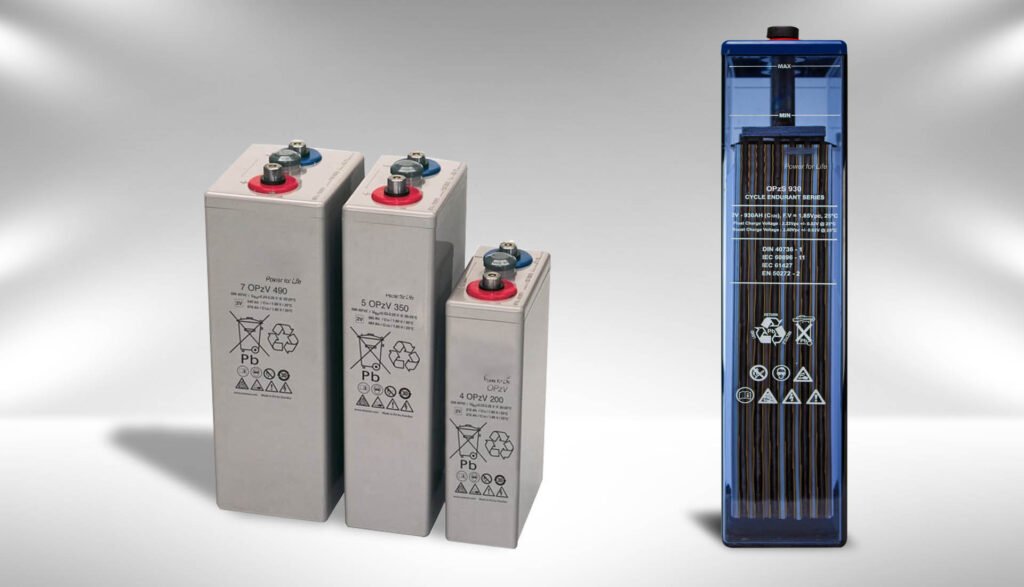
For large off-grid or commercial battery banks, heavy-duty 2V tubular cells are the usual choice. See our OPzS vs OPzV battery guide for how the flooded and gel versions compare.
Lithium Battery Prices in Nigeria 2026
Small Lithium Batteries (12V Units)
For smaller 12V inverter systems, a 12V 200Ah Lithium (LiFePO4) battery costs between ₦315,000 and ₦470,000 — while more expensive than a 200Ah gel battery, it lasts 4 times longer and is much lighter.
| Capacity | Price Range (₦) |
|---|---|
| 12V 100Ah LiFePO4 | ₦180,000 – ₦285,000 |
| 12V 200Ah LiFePO4 | ₦315,000 – ₦470,000 |
| 24V 100Ah LiFePO4 | ₦280,000 – ₦420,000 |
Mid-Range Lithium Battery Packs (48V Systems)
These are the most common lithium battery packs used with 3kVA to 5kVA hybrid inverters in Nigerian homes:
| Capacity | Price Range (₦) |
|---|---|
| 2.5kWh (48V/51Ah) | ₦580,000 – ₦695,000 |
| 5kWh (48V/100Ah) | ₦995,000 – ₦2,148,000 |
| 7.5kWh | ₦1,500,000 – ₦2,800,000 |
High-Capacity Lithium Battery Packs (Large Homes & Commercial)
| Capacity | Price Range (₦) |
|---|---|
| 10kWh | ₦1,136,897 – ₦3,100,000 |
| 15kWh | ₦2,300,000 – ₦4,200,000 |
| 20kWh+ | ₦4,000,000 – ₦5,500,000+ |
Solar Battery Prices by Brand in Nigeria 2026
Brand matters less to price than chemistry and size: in October 2026 a Felicity 5kWh lithium pack sells for about ₦1,400,000 to ₦1,650,000 and a Felicity 10kWh for about ₦2,650,000, while a Luminous 220Ah tubular is about ₦435,000 (see our Felicity price guide and Luminous price guide). For our ranked picks by budget, including Felicity, Deye, Pylontech and Luminous with warranties compared, read the best solar batteries in Nigeria.
Lithium vs Tubular — Which Battery Is Better for Nigeria?
This is the most important decision Nigerian solar buyers face in 2026. Here is an honest, detailed comparison:
| Feature | Lithium LiFePO4 | Tubular Lead-Acid |
|---|---|---|
| Upfront cost (200Ah equivalent) | ₦315,000 – ₦470,000 | ₦155,000 – ₦280,000 |
| Lifespan | 10 – 15 years | 3 – 5 years |
| Maintenance | Zero | Water topping every 2–3 months |
| Depth of discharge | 80% – 90% | 50% maximum |
| Charge speed | Fast | Slow |
| Heat tolerance | ✅ Good | ⚠️ Poor in Nigerian heat |
| Weight | Light | Heavy |
| Long-term cost (10 years) | Buy once | Buy 2–3 times |
| Best for | Long-term value | Tight upfront budget |
The honest verdict: Lithium batteries cost more upfront but last 10 to 15 years with zero maintenance, while tubular batteries last 3 to 5 years and need regular maintenance. When you calculate the total cost over 10 years — including 2 to 3 tubular battery replacements plus maintenance — lithium is almost always cheaper in the long run.
If you have the budget, choose lithium (like Deye or Felicity) for a “set it and forget it” system that lasts 10 or more years.
How Many Batteries Do You Need for Your Home in Nigeria?
| Home Size | Inverter Size | Battery Recommendation | Estimated Battery Cost |
|---|---|---|---|
| Single room | 1kVA – 1.5kVA | 1 x 200Ah Tubular OR 1 x 100Ah Lithium | ₦155,000 – ₦285,000 |
| 1 bedroom flat | 1.5kVA – 2kVA | 2 x 200Ah Tubular OR 2.5kWh Lithium | ₦310,000 – ₦695,000 |
| 2 bedroom flat | 2kVA – 3.5kVA | 4 x 200Ah Tubular OR 5kWh Lithium | ₦620,000 – ₦2,148,000 |
| 3 bedroom house | 5kVA | 4–6 x 200Ah Tubular OR 5–10kWh Lithium | ₦780,000 – ₦3,100,000 |
| 4–5 bedroom house | 7.5kVA – 10kVA | 8+ x 200Ah Tubular OR 10–15kWh Lithium | ₦1,240,000 – ₦4,200,000 |
Common mistake: Buying a big inverter with a small battery. A 5kVA inverter paired with only 1 x 200Ah battery will always disappoint you — you will run out of power within 1 to 2 hours. Always size your battery bank to match your load and the number of hours you need backup power.
Complete System Cost Including Batteries
For 2026, estimated prices for combined systems are: a 1.5kVA system with one 200Ah battery and 1.5kVA inverter costs ₦650,000 to ₦750,000; a 3.5kVA system with two 200Ah batteries and 3.5kVA inverter costs ₦1,100,000 to ₦1,400,000; a 5kVA system with one 5kWh lithium battery and 5kVA inverter costs ₦1,700,000 to ₦2,200,000.
5 Factors That Affect Solar Battery Prices in Nigeria
1. Battery Technology Lithium batteries cost 2 to 3 times more than tubular batteries of equivalent capacity but last 3 to 4 times longer. The technology you choose is the biggest price driver.
2. Capacity (Ah or kWh) More storage capacity means higher price. A 200Ah battery costs roughly double a 100Ah battery of the same chemistry and brand.
3. Brand Premium brands like Felicity, Deye, Pylontech, and BYD cost more than lesser-known brands but come with better warranty support, more reliable BMS (battery management systems), and greater compatibility with leading hybrid inverters.
4. Naira Exchange Rate Most batteries sold in Nigeria are imported. Sharp daily changes in the naira exchange rate cause market prices to adjust quickly. This is why battery prices can shift by ₦20,000 to ₦50,000 within a single week during periods of naira volatility.
5. Vendor Location Battery prices in cities like Lagos and Abuja, which are close to import distribution hubs, tend to be lower than prices in smaller cities farther from the ports. Transport and logistics add to the cost in remote locations.
5 Things to Check Before Buying a Solar Battery in Nigeria
- Confirm it is a genuine deep-cycle battery — Not all batteries sold as solar batteries are designed for deep cycling. Ordinary car batteries will fail within 3 to 6 months when used in solar applications.
- Ask for the cycle rating — A quality tubular battery should have at least 1,200 cycles. A quality LiFePO4 lithium battery should have at least 4,000 to 6,000 cycles.
- Check the warranty document — A reputable brand should provide at least 12 to 24 months warranty. No warranty document means no protection.
- Match the battery voltage to your inverter — Most home inverters use 12V, 24V, or 48V battery banks. Confirm your inverter’s voltage requirement before buying.
- Buy from authorised dealers — Refurbished and recycled batteries are commonly sold as new in open markets. Buy from certified solar dealers with proper documentation.
100Ah vs 200Ah lithium battery: which do you need?
A 200Ah lithium battery stores twice the energy of a 100Ah one at the same voltage, but usually costs only about 1.6 to 1.8 times as much. The catch is that “100Ah” means very different things at different voltages. LiFePO4 batteries are built at 12.8V, 25.6V or 51.2V, so a 12V 100Ah battery holds about 1.28kWh, while a 48V 100Ah pack holds 5.12kWh, four times as much. Always compare kWh, not Ah.
| Lithium battery | Total / usable energy (90%) | Price seen (₦) | What it runs | Suits |
|---|---|---|---|---|
| 12V 100Ah | 1.28kWh / about 1.15kWh | ₦230,000 – ₦320,000 | A 150W load (fan, TV, lights, router) for about 7.5 hours | 1kVA – 1.5kVA 12V inverter |
| 12V 200Ah | 2.56kWh / about 2.3kWh | ₦400,000 – ₦550,000 | A 150W load for about 15 hours, or 300W for about 7.5 hours | 1.5kVA – 2kVA 12V inverter |
| 24V 100Ah | 2.56kWh / about 2.3kWh | ₦580,000 – ₦850,000 | A 300W load (fans, TV, lights, small fridge) for about 7.5 hours | 2kVA – 3.5kVA 24V inverter |
| 24V 200Ah (5kWh) | 5.12kWh / about 4.6kWh | ₦1,150,000 – ₦1,700,000 | A 500W load for about 9 hours | 3.5kVA 24V inverter |
| 48V 100Ah (5kWh) | 5.12kWh / about 4.6kWh | ₦1,100,000 – ₦1,650,000 | A 500W load for about 9 hours | 3.5kVA – 5kVA 48V inverter |
| 48V 200Ah (10kWh) | 10.24kWh / about 9.2kWh | ₦1,850,000 – ₦2,900,000 | A 1HP AC plus fans and lights (about 1,150W) for about 8 hours | 5kVA – 10kVA 48V inverter |
Here is the maths for the most common home pack, a 48V 100Ah: 51.2V × 100Ah = 5,120Wh. At 90% depth of discharge, that is 5,120 × 0.9 = 4,608Wh usable. Divide by a 500W evening load: 4,608 ÷ 500 ≈ 9.2 hours. Double the Ah to 200Ah and you get about 18 hours on the same load. Inverter losses take off roughly 5–10%, so plan for a little less.
On price, 48V 100Ah packs were selling for about ₦1,100,000 to ₦1,650,000 in October 2026 (Felicity’s 5kWh was about ₦1,650,000 at Zit), while 48V 200Ah packs ran from about ₦1,850,000 to ₦2,900,000 (Felicity’s 10kWh was about ₦2,650,000). So the bigger pack costs less per kWh, but you pay the difference all at once.
Which should you buy? Choose 100Ah if you are on Band A or B with long hours of NEPA supply and only need fans, TV, lights and a fridge at night. Choose 200Ah, or two matching 100Ah packs in parallel, if you are on Band C to E, run a freezer or pumping machine, or want an inverter AC through the night. Whatever you pick, the battery voltage must match your inverter: a 24V battery will not work on a 48V inverter. Our solar load calculator helps you size it.
Frequently Asked Questions
Q: How much is a solar battery in Nigeria in 2026? Solar battery prices in Nigeria range from ₦155,000 for budget 200Ah tubular batteries to over ₦5,500,000 for large 15kWh to 20kWh lithium battery systems. The most popular choice for a 3-bedroom home — a 5kWh LiFePO4 lithium pack — costs between ₦995,000 and ₦2,148,000 depending on brand.
Q: Which solar battery is best for Nigeria in 2026? Felicity Solar and Blue Carbon are currently the top-rated brands in Nigeria due to their high cycle life of up to 6,000 cycles, local warranty support, and compatibility with most hybrid inverters including Growatt, Deye, and Victron. For high-end use, BYD and Pylontech are preferred for their advanced battery management systems. See our best solar batteries in Nigeria guide for picks by budget.
Q: Is lithium or tubular battery better for Nigeria? For long-term value, lithium LiFePO4 batteries are the better choice. They last 10 to 15 years compared to 3 to 5 years for tubular batteries, require zero maintenance, perform better in Nigeria’s heat, and cost less over 10 years when you factor in tubular replacements. If your budget is tight upfront, tubular batteries remain a practical starting point.
Q: How many batteries do I need for a 5kVA inverter in Nigeria? For a 5kVA inverter in a 3-bedroom home, the recommended battery setup is 4 to 6 pieces of 200Ah tubular batteries wired in the correct configuration, or one 5kWh to 10kWh lithium battery pack. The exact number depends on how many hours of backup power you need and the total load you plan to run.
Q: How long does a solar battery last in Nigeria? Quality tubular batteries last 3 to 5 years with proper maintenance in Nigerian conditions. LiFePO4 lithium batteries last 10 to 15 years. Heat is the biggest enemy of battery lifespan in Nigeria — always install batteries in a cool, ventilated area away from direct sunlight.
Summary — Solar Battery Price in Nigeria 2026
| Battery Type | Capacity | Price Range (₦) |
|---|---|---|
| Tubular Lead-Acid | 200Ah | ₦155,000 – ₦420,000 |
| Gel / AGM | 200Ah | ₦160,000 – ₦350,000 |
| LiFePO4 Lithium | 200Ah (12V) | ₦315,000 – ₦470,000 |
| LiFePO4 Lithium Pack | 2.5kWh | ₦580,000 – ₦695,000 |
| LiFePO4 Lithium Pack | 5kWh | ₦995,000 – ₦2,148,000 |
| LiFePO4 Lithium Pack | 10kWh | ₦1,136,897 – ₦3,100,000 |
| LiFePO4 Lithium Pack | 15kWh | ₦2,300,000 – ₦4,200,000+ |
Your battery is the heart of your solar system. Getting it right from the start — in terms of type, capacity, brand, and configuration — is the single most important factor in whether your solar investment delivers value for years or disappointment within months.
Related Articles on Solar Energy Supply Stores
- [Solar Inverter Price in Nigeria — Complete Brand Guide]
- [Solar Panel Prices in Nigeria 2026 — Complete Price List]
- [How Much Does a Complete Solar System Cost in Nigeria?]
- [Best Solar Inverter in Nigeria — 2026 Buyer’s Guide]
Prices are based on Nigerian market research; the tubular and 100Ah vs 200Ah sections were checked in October 2026. Battery prices change regularly with the naira exchange rate. Always confirm with your vendor before purchasing. Last updated: October 2026.


Leave a Reply


- Trending
- Latest
- Comments








Solar Energy Supply Stores provides current solar prices in Nigeria, expert product reviews, comparisons, and practical buying guides for solar panels, inverters, batteries, generators, and complete solar systems nationwide.
Comments 14