No products in the cart.


How Many Solar Panels to Power an Off-Grid House
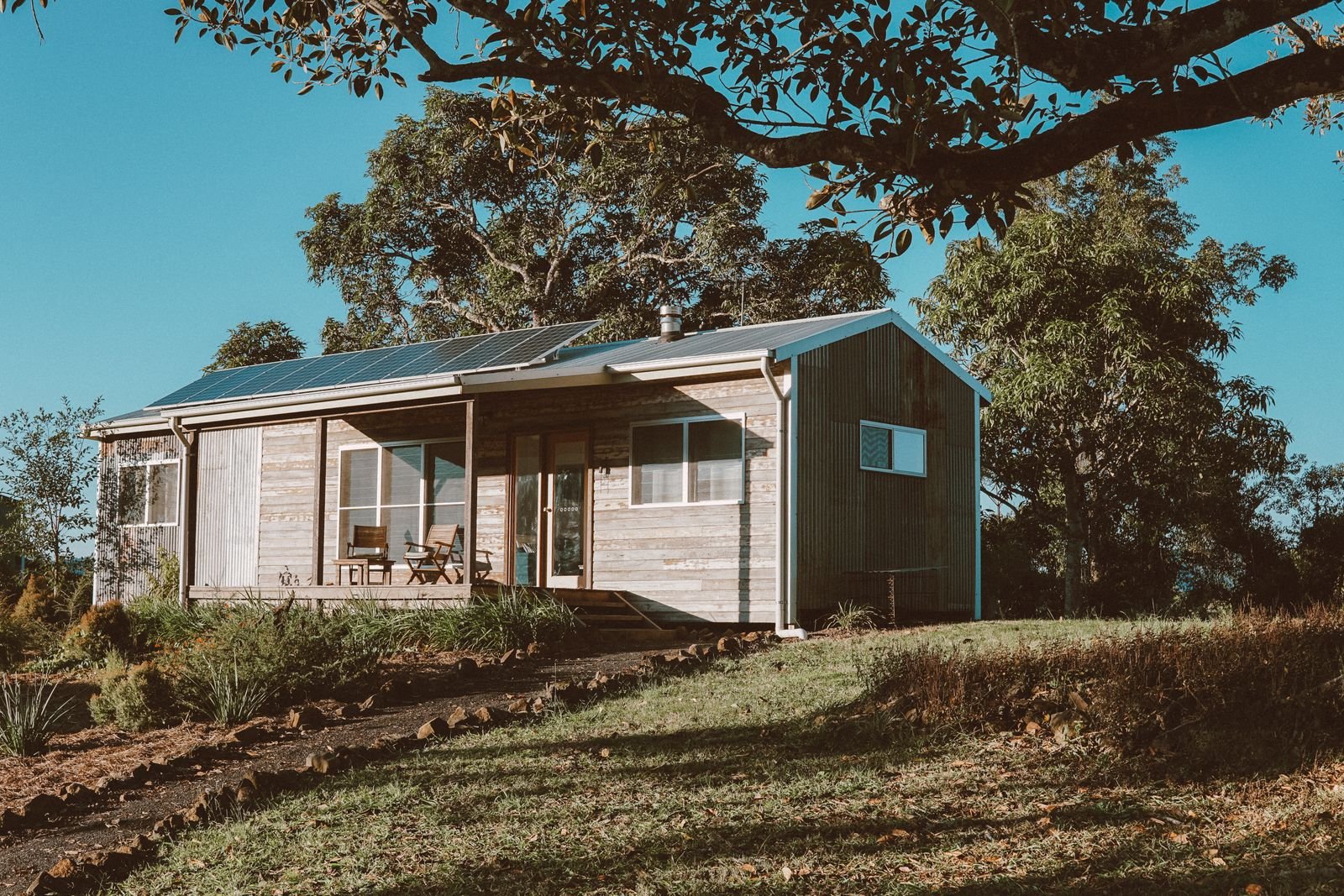
An off-grid house that uses 20 kWh a day typically needs about 15–27 solar panels (400 W each), or roughly 6–11 kW, depending on how much winter sun you get. Off-grid systems must be sized for the darkest month, not the yearly average, and paired with enough battery to cover 2–3 cloudy days. Here is how to work out your own number.

Quick answer
- Formula: daily kWh ÷ (winter sun hours × 0.75) = kW of panels needed.
- Typical off-grid home (20 kWh/day): about 15 panels in the sunny Southwest, 20 in mid-latitude states, and 27 in cloudy northern winters.
- Average US home (about 30 kWh/day): about 23–40 panels off-grid. Most off-grid homes cut their use first.
- Batteries: plan for 2–3 days of storage. For 20 kWh a day, that is about 44 kWh of LiFePO4.
- Backup: most off-grid homes keep a generator for long winter storms.
How is off-grid solar sizing different from grid-tied?
A grid-tied system can come up short in December and make up for it in June. The grid fills the gap. An off-grid system has no grid to lean on. If the panels and batteries run dry, the lights go out.
That changes three things:
- You size for the worst month, not the yearly average.
- You add more losses. Power that goes into and out of a battery, plus wiring, heat and dust, costs about 25% of output. We use a 0.75 factor.
- You need storage for bad weather, called “days of autonomy.”
How do I do a load audit for an off-grid house?
Start with how much energy you use per day. If you are moving from a grid-tied home, your utility bill shows monthly kWh. Divide by 30. The average US home bought about 899 kWh a month in 2022 (EIA), which is about 30 kWh a day.
For a new build or cabin, list every appliance. Multiply watts by hours of use to get watt-hours, then divide by 1,000 for kWh. Here is a sample audit for an efficient all-electric off-grid home in winter:
| Load | Estimate | kWh per day |
|---|---|---|
| Energy Star refrigerator | about 430 kWh per year ÷ 365 | 1.2 |
| Chest freezer | about 290 kWh per year ÷ 365 | 0.8 |
| LED lights | 10 bulbs × 10 W × 5 hours | 0.5 |
| Well pump | 1,000 W × 1 hour | 1.0 |
| Electronics (TV, Wi-Fi, laptops, phones) | about 125 W × 12 hours | 1.5 |
| Induction cooking and microwave | 2,000 W × 1 hour | 2.0 |
| Heat pump water heater | 500 W × 5 hours | 2.5 |
| Mini-split heat pump (heating) | 1,000 W × 8 hours | 8.0 |
| Washer, dryer and other | varies | 2.5 |
| Total | 20.0 |
Notice the heating line. Space heating is often the biggest winter load. Many off-grid homes heat with wood or propane to keep the solar system smaller. Avoid electric resistance heat, baseboard heaters and standard electric water heaters if you can. A single 4,500 W water heater element running 3 hours uses 13.5 kWh, almost as much as the rest of this house.
How many sun hours should I design for?
Most of the US gets 4–6 peak sun hours a day on average. Winter is lower. December can drop to about 2–3 hours in the Northeast, Northwest and upper Midwest, about 3.5 in the middle of the country, and 4.5 or more in the desert Southwest.
Look up your own winter numbers with NREL’s free PVWatts tool. Enter your address and check the monthly output for December or January. Snow cover and short days both matter. Our post on whether solar panels work in winter explains what to expect.
How many solar panels to power a house off-grid? A worked example
Take the 20 kWh-per-day home above, in a state with 3 winter sun hours.
- Adjust for losses: 3 sun hours × 0.75 = 2.25 usable kWh per kW of panels per day.
- Find array size: 20 kWh ÷ 2.25 = 8.9 kW of panels.
- Convert to panels: 8.9 kW ÷ 0.4 kW per panel = 22.2. Round up to 23 panels (9.2 kW).
- Check space: 23 panels × 21 sq ft = 483 sq ft of roof or ground.
Ground mounts are common off-grid. They let you tilt panels steeply for winter sun and clear snow easily.
| Daily use | 2.5 winter sun hours | 3.5 winter sun hours | 4.5 winter sun hours |
|---|---|---|---|
| 10 kWh/day | 14 panels (5.6 kW) | 10 panels (4 kW) | 8 panels (3.2 kW) |
| 20 kWh/day | 27 panels (10.8 kW) | 20 panels (8 kW) | 15 panels (6 kW) |
| 30 kWh/day | 40 panels (16 kW) | 29 panels (11.6 kW) | 23 panels (9.2 kW) |
Want a quick estimate for your ZIP code? Try our solar power calculator, then add 25–35% for off-grid losses and winter.
How many days of battery backup do I need?
Batteries carry you through nights and cloudy stretches. Most designers plan for 2–3 days of autonomy, plus a generator for longer storms.
- Storage needed: 20 kWh per day × 2 days = 40 kWh usable.
- Adjust for depth of discharge: LiFePO4 batteries are usually run to about 90%. 40 kWh ÷ 0.9 = 44.4 kWh of rated capacity.
- Compare to home batteries: 44.4 ÷ 13.5 kWh = 3.3, so about three to four 13.5 kWh units.
Lead-acid batteries should only be drained to about 50%, so you would need about 80 kWh of rated lead-acid capacity for the same job. That is why most new off-grid builds use lithium. See LiFePO4 vs lead acid for the cost-per-cycle math, and how many solar batteries to run a house for more on battery sizing.
What size inverter does an off-grid house need?
Your inverter must handle the most power you use at one time, not the daily total. Add up loads that could run together, such as the well pump, microwave, heat pump and washer. Then check startup surge. Well pumps and compressors can pull several times their running watts for a moment.
Many off-grid homes use an 8–12 kW 120/240 V inverter, sometimes two stacked units. Our guide on what size solar inverter you need covers surge, split-phase output and off-grid vs hybrid models.
How much does an off-grid solar system cost?
Costs vary a lot by design and labor, so treat these as rough numbers:
- Panels and install: 9.2 kW × $2.60 per watt = $23,920 at the US installed average (grid-tied pricing; off-grid installs can cost more).
- Batteries: installed home batteries average about $15,600 per 13.5 kWh (EnergySage, July 2026). 3.3 units × $15,600 ≈ $51,000. DIY rack batteries cost less, but prices change often.
- Extras: off-grid inverter, generator, wiring and permits.
Cutting your load is the cheapest step. Every kWh you remove from the daily audit saves about one panel’s worth of winter output and about 2 kWh of battery. See solar panel cost in the US for current pricing by system size.
Safety note: A whole-home off-grid system runs at 120/240 V with large battery banks. Hire a licensed electrician. Work must follow the National Electrical Code (NEC), and most counties require permits and inspection even when you are not connected to a utility.
Frequently asked questions
Can 10 solar panels power an off-grid house?
Only a very efficient one. Ten 400 W panels can support about 10 kWh a day in a sunny winter climate (3.5 sun hours). That covers a small cabin or tiny home, not a typical family house.
Do I need a generator with off-grid solar?
Most off-grid owners keep one. Sizing panels and batteries for the worst week of the year costs far more than a generator that runs a few days a year.
Should I size for winter or summer?
Winter, unless you will rely on a generator in winter. Summer production will then be higher than you need, which is normal for off-grid homes.
How much land do off-grid panels need?
About 21 sq ft per 400 W panel, plus spacing between rows on a ground mount. A 23-panel array needs roughly 483 sq ft of panel area.
Sources
- U.S. Department of Energy: Off-Grid or Stand-Alone Renewable Energy Systems
- NREL PVWatts Calculator
- EIA: How much electricity does an American home use?
- ENERGY STAR: Refrigerators
Last updated: October 2026. Figures are estimates; an off-grid design should be checked by a qualified installer for your site. This article is for information only and is not electrical advice.




Leave a Reply


- Trending
- Latest
- Comments









Solar Energy Supply Stores provides current solar prices in Nigeria, expert product reviews, comparisons, and practical buying guides for solar panels, inverters, batteries, generators, and complete solar systems nationwide.
Comments 2