No products in the cart.


Solar TV Price in Nigeria (2026): DC Televisions, Kits & Brands

A solar TV in Nigeria costs about ₦115,000 to ₦285,000 for a 32-inch DC TV kit, ₦143,000 to ₦396,000 for 24 inches and ₦376,000 to ₦630,000 for 43 inches (prices seen on Jumia, Jiji and SunKing Nigeria in October 2026). The cheapest kits come from Miratec and Yobolife; SunKing costs more but includes installation, a lithium battery and a two-year warranty.

Quick answer
- 24″ kit: ₦143,000–₦148,000 (Yobolife) or ₦396,000 (SunKing HomePlus Max).
- 32″ kit: ₦115,000–₦285,000 (Miratec, Yobolife) or ₦514,000 (SunKing with fan).
- 43″ kit: ₦376,000 (Yobolife) to ₦630,000 (SunKing).
- Power use: a DC solar TV draws about 10–15W; a normal 32″ TV on an inverter uses 3–5 times more energy.
- Best for: homes with little or no NEPA that want TV and lights without a generator.
Prices move with the naira exchange rate, because the panels, batteries and screens are imported. Check the current price before you pay.
What is a solar TV?
A solar TV is an LED television built to run on 12V DC power straight from a battery that a solar panel charges. Because it skips the inverter, it wastes almost no power converting electricity. Most solar TVs sold here are “AC/DC” models, so you can also plug them into NEPA when the light is on.
You can buy one in two ways:
- TV-plus-panel kit: TV, solar panel, battery box and usually 4 LED bulbs in one package. This is how SunKing, Yobolife and BaobabPlus sell them.
- DC TV only: just the screen, which you connect to your own 12V battery or a solar generator with a 12V DC port.
How much is a solar TV in Nigeria by size?
| Size | Price range (₦) | What you get |
|---|---|---|
| 19″ | about 52,000 | AC/DC TV only (no panel or battery) |
| 24″ | 143,000 – 396,000 | Yobolife kit with 28W panel and 4 bulbs; SunKing HomePlus Max kit |
| 32″ | 115,000 – 514,000 | Miratec, Yobolife and SunKing kits; some include a small inverter or power station |
| 43″ | 376,000 – 630,000 | Yobolife smart kit; generic smart kit; SunKing HomePlus Max kit |
The wide ranges come from what is in the box. A ₦115,000 32-inch listing and a ₦514,000 32-inch kit are not the same thing. The cheap one has a small battery and no installation. The expensive one has a lithium battery rated for years of daily cycling, installation and a warranty.
Which solar TV brands are sold in Nigeria?
SunKing solar TV
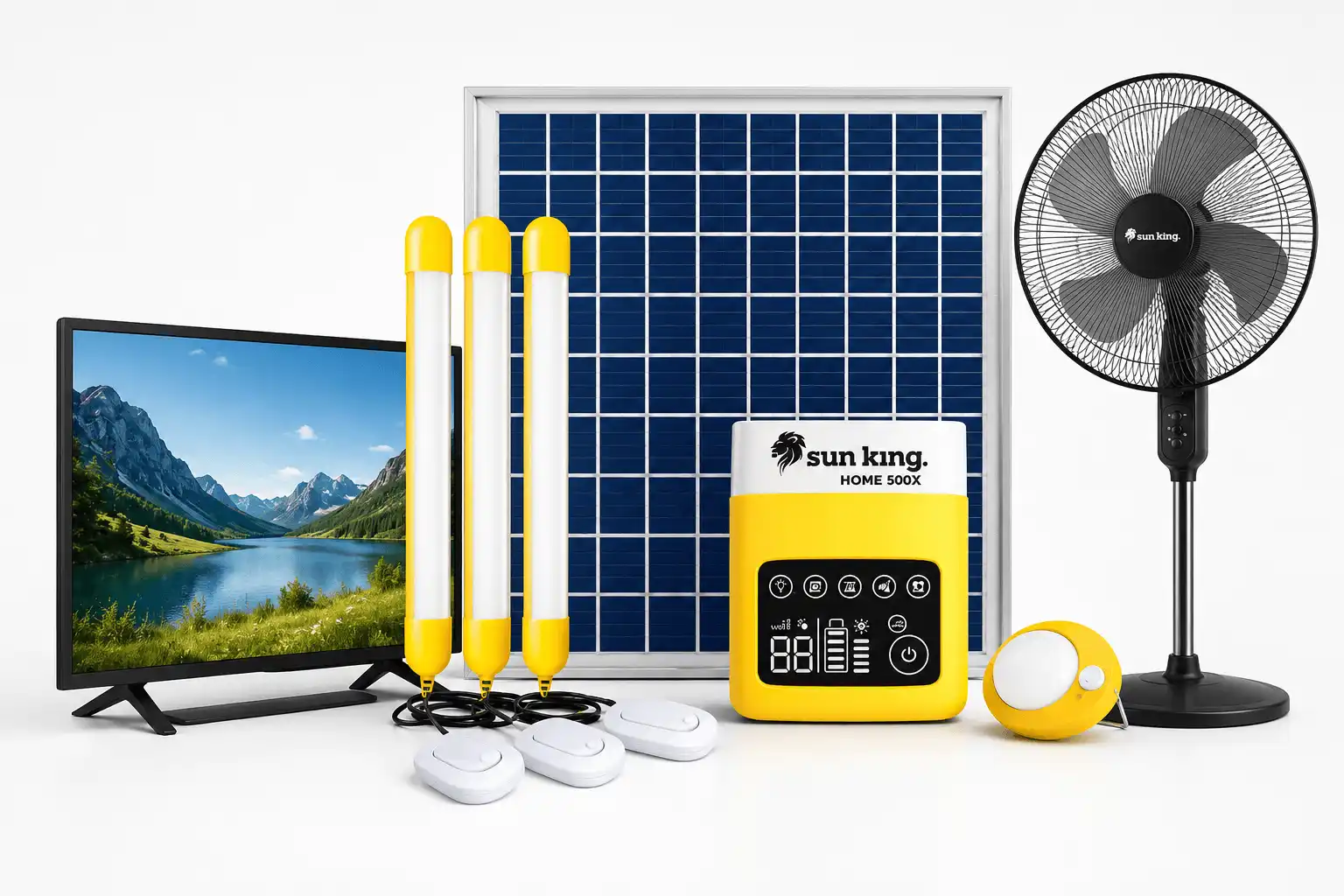
SunKing sells its TVs bundled with the HomePlus Max solar home system. Every bundle includes an 80W monocrystalline panel, a 192Wh lithium (LFP) battery, four tube lights, a motion-sensing security lamp, phone charging, free installation and a two-year warranty.
| SunKing bundle | Cash price (₦) | EasyBuy |
|---|---|---|
| HomePlus Max + 24″ HD TV | 396,000 | ₦20,000 deposit + ₦9,500 weekly × 80 |
| HomePlus Max + 32″ HD TV + pedestal fan | 514,000 | ₦27,000 deposit + ₦12,300 weekly × 80 |
| HomePlus Max + 43″ HD TV | 630,000 | ₦33,500 deposit + ₦15,000 weekly × 80 |
EasyBuy costs much more in total. For the 32″ bundle: ₦27,000 + (80 × ₦12,300) = ₦27,000 + ₦984,000 = ₦1,011,000, almost double the ₦514,000 cash price. You pay for the convenience of no bank account and no guarantor. Our SunKing solar price guide covers the rest of the range, and our pay-small-small solar page compares other instalment options.
Yobolife
Yobolife sells “rechargeable” AC/DC TVs with a built-in battery, 4 bulbs and a 28W or 35W panel. Listed wattage is 10W for the 24″ and 15W for the 32″ and 43″. Prices seen: 24″ about ₦143,000–₦148,000, 32″ about ₦233,000–₦285,000 and 43″ smart about ₦376,000.
Miratec
Miratec has the most 32″ listings on Jumia, all rated at 15W. The TV alone was about ₦130,000–₦153,000. Combo kits pair it with a 26Ah battery, a small 1,000W inverter and a 100W panel (listed from about ₦115,000 on sale), or with an ESS-500 power station and 200W of panels (₦134,000 to ₦390,000 depending on the listing). Read exactly what each listing includes before paying.
BaobabPlus, Lontor and others
BaobabPlus, a pay-as-you-go solar company, lists a 32″ solar TV with 4 bulbs and a two-year warranty, at about ₦861,000 on Jumia. That is high for the size, so compare it carefully. Lontor is well known in Nigeria for rechargeable fans and lamps, but we could not find a Lontor solar TV on sale in October 2026. Be careful with any listing that uses the name without a model number. Small unbranded 19″ AC/DC TVs also sell for about ₦52,000 without a panel.
How much power does a solar TV use compared with a normal TV?
This is where solar TVs win. Here is a 6-hour evening of viewing on each setup:
- 32″ DC solar TV: 15W × 6 hours = 90Wh.
- Normal 32″ LED TV on an inverter: about 40W × 6 hours = 240Wh.
- Add the inverter’s own idle draw, typically 20–30W for a small home inverter: 25W × 6 hours = 150Wh.
- Total for the normal TV: 240 + 150 = 390Wh, over 4 times the solar TV.
| Setup | Power draw | 6 hours of TV |
|---|---|---|
| 24″ DC solar TV | about 10W | 60Wh |
| 32″ DC solar TV | about 15W | 90Wh |
| 43″ DC solar TV | about 15W (Yobolife listing) | 90Wh |
| Normal 32″ TV + inverter idle | about 65W | 390Wh |
| Normal 43″ TV + inverter idle | about 85–105W | 510–630Wh |
What does that mean in practice? SunKing’s 192Wh battery could, on paper, run a 15W TV for about 12 hours (192 ÷ 15 = 12.8) if nothing else were on. With lights also running, plan on an evening of TV, not all night. To run a normal TV for the same 6 hours, you need roughly a 12V 100Ah battery and a 1kVA inverter, plus 200W or more of panels to refill it.
Solar TV kit or a normal TV on a solar generator: which is better?
Choose a solar TV kit if: you have little or no NEPA, you want TV and lights only, and you want the lowest possible cost. It is popular in rural areas, in estates still waiting for a transformer, and for a boys’ quarters or a small shop.
Choose a normal TV on a solar generator or inverter if: you already own a smart TV, you also want to run a fan, a decoder and a small fridge, or you want one system for the whole room. A 1kVA unit such as the Qasa SPG-1200 solar power generator can run a TV, decoder and fan together. See our solar generator price guide for more options, or work out your full load with the solar load calculator.
One catch with DC TVs: your GOtv, DStv or Startimes decoder still needs power. Some kits have a spare 12V port or come with a small inverter. Check before you buy, or confirm that the TV’s built-in tuner picks up the free-to-air channels you want.
What should you check before buying a solar TV?
- Battery type and size: lithium (LFP) lasts far longer than a small lead-acid or “gel” battery. Ask for the Wh or Ah figure in writing.
- Panel wattage: a 28W–35W panel charges slowly in the rainy season. 80W or more gives a better buffer.
- Warranty and service centre: SunKing and BaobabPlus offer two years. Many marketplace kits offer little or none.
- Seller: buy from the brand, its agents, or a Jumia official store. Be wary of Computer Village or Alaba stalls selling unbranded kits with no receipt.
- Total EasyBuy cost: multiply the weekly payment by the number of weeks and add the deposit before you sign.
Frequently asked questions
How much is a 32-inch solar TV in Nigeria?
About ₦115,000 to ₦285,000 for Miratec and Yobolife kits, and ₦514,000 cash for SunKing’s HomePlus Max 32″ bundle with a fan (October 2026).
Can a solar TV work without sunlight?
Yes, from its battery. The panel charges the battery in the day and you watch at night. After several cloudy days the battery may run low. Most AC/DC models can then run on NEPA.
Can I connect a solar TV to my inverter?
An AC/DC model can plug into an inverter, but you lose the main benefit. Running it directly from a 12V battery avoids the inverter’s idle draw.
Is SunKing’s solar TV worth the higher price?
If you value installation, a lithium battery and a two-year warranty, yes. If you are on a tight budget and comfortable setting it up yourself, a Yobolife or Miratec kit costs far less.
Need a bigger system for your TV, fans and fridge? Visit our shop for a quote.
Sources
- SunKing Nigeria: HomePlus Max + 32″ HD TV + pedestal fan
- SunKing Nigeria: HomePlus Max + 24″ HD TV
- Jumia Nigeria: solar TV listings
- Jiji.ng: SunKing TV listings
Last updated: October 2026. Prices are from SunKing Nigeria and marketplace listings seen in October 2026 and change with the naira exchange rate and seller. Power figures for normal TVs and inverters are typical estimates. This article is for information only and is not financial advice.


Leave a Reply


- Trending
- Latest
- Comments





Solar Energy Supply Stores provides current solar prices in Nigeria, expert product reviews, comparisons, and practical buying guides for solar panels, inverters, batteries, generators, and complete solar systems nationwide.
Comments 1